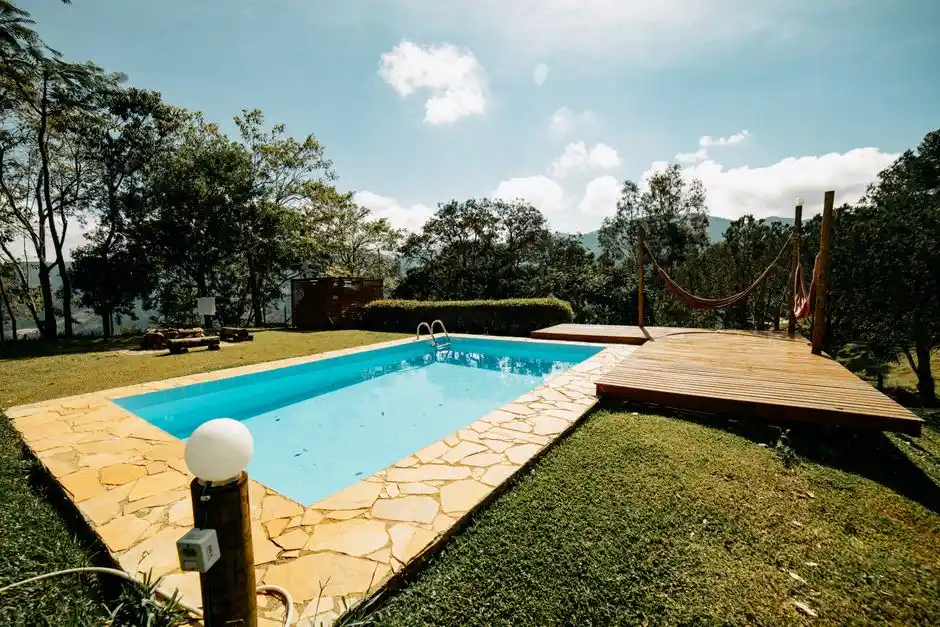
Your pool is losing water because it is either evaporating normally or leaking through a crack, fitting, or plumbing line that you cannot see from the deck. In Brea, a typical uncovered pool loses about a quarter inch of water per day to evaporation in summer, and anything past that - especially overnight, when evaporation nearly stops - points to a real leak. The rest of this post walks you through how to measure your loss, what is normal for our climate, the most common failure points on Brea pools, and when it is time to call someone.
How much water a Brea pool should lose per day
A healthy uncovered pool in Brea loses roughly 1/8 to 1/4 inch of water per day in warm weather, and closer to 1/8 inch or less from November through February. That works out to about 2 to 4 inches a week at the peak of summer, which is why a lot of homeowners do not notice a slow leak until the water drops below the skimmer.
Here is the number that matters most: overnight loss. Evaporation drops to almost nothing after dark, so if your pool drops more than 1/8 inch between 9 p.m. and 7 a.m., you have a leak. A pool losing water overnight in Brea California is almost never an evaporation problem.
Use the bucket test to confirm it. Fill a bucket with pool water, set it on the first or second step so the water inside matches the pool level, and mark both levels with tape. Check again in 24 hours. If the pool dropped more than the bucket, the difference is your leak rate.
Why Brea pools lose water faster than you'd expect
Brea sits in a spot where hot inland air, dry Santa Ana wind events, and heavy clay soil all work against a pool at the same time. Three local factors drive most of the water loss we see:
- Low humidity. Inland North Orange County regularly drops below 30% relative humidity in fall and winter. Dry air pulls water off the surface far faster than coastal humidity does.
- Santa Ana winds. When those winds push through the Coyote Hills and Tonner Canyon corridors, surface evaporation can triple for a few days. A pool that looks fine in June can drop an inch a day in October.
- Expansive clay soil. Much of Brea - especially the older tracts near Downtown Brea and the neighborhoods built in the 1960s and 70s - sits on clay that swells when wet and shrinks when dry. That movement is hard on buried pool plumbing and on the shell itself.
Add a spa spillway, a waterfall, or a deck jet and your baseline loss climbs another 1/8 to 1/4 inch per day. Splash-out from kids and dogs counts too. Before you assume the worst, shut those features off for 48 hours and re-run the bucket test.
Is my pool leaking or evaporating in Brea California?
Evaporation is uniform and predictable; a leak is not. That difference is the whole test. A pool that loses the same amount every day, rain or shine, wind or calm, is evaporating. A pool that loses more on some days than others, or that drops noticeably overnight, is leaking.
Four signals separate the two:
- Timing. Evaporation happens in daylight. Leaks happen around the clock.
- Location of the drop. If the water stops falling at a specific point - say, right at the bottom of the tile line or just below the skimmer mouth - the leak is at that level.
- Wet spots. Soggy grass, a permanently damp patch of deck, or a soft spot in the yard is a plumbing or shell leak, not evaporation.
- Chemistry drift. A leaking pool loses stabilizer and salt faster than it loses water, because the leak is pulling out pool water while evaporation leaves minerals behind. If your CYA or salt keeps dropping without a drain and refill, that is a leak signature.
If you have already ruled out evaporation and you want the source pinpointed without tearing up your deck, our Pool Leak Detection Brea CA service uses pressure testing and acoustic listening to isolate the exact failure point before anyone picks up a shovel.
The most common places a Brea pool leaks
After enough Brea pool leak calls, the same handful of failure points show up again and again. Here is where we find them, roughly in order of frequency.
Light niches and skimmer throats
The plastic ring around a pool light and the seam where the skimmer meets the shell are the two most common leak sites on any pool. Both rely on a sealant that hardens and shrinks over 8 to 12 years. A dye test at the niche usually confirms it in under a minute.
Return fittings and the equipment pad
Return eyeballs, the pump union, the filter drain plug, and the heater bypass all sit on the pressure side of the system. A puddle that never dries under the pump is a pressure-side leak, and it will not show up as water loss until it gets bad.
Underground return and suction lines
Buried PVC under a Brea pool deck takes a beating from clay soil movement. A hairline crack at a 90-degree elbow can leak hundreds of gallons a week into the soil without ever surfacing. This is where Acoustic Leak Detection Brea CA earns its keep - we pressurize the line, then listen for the hiss through the deck to mark the spot within a few inches.
The shell itself
Plaster pools in Brea that are 15 years or older often develop hairline cracks in the shell. Some are cosmetic. Some weep steadily. A dye test along the crack tells you which one you are dealing with.
How to find a pool leak in Brea CA yourself
You can narrow down a Brea pool leak to one of three zones - shell, plumbing, or equipment - in about an hour with no special tools. Here is the sequence we walk homeowners through on the phone.
- Mark the water level. Tape a piece of painter's tape at the waterline and check it every 12 hours for two days. Write down the numbers.
- Run the bucket test. As described above. This tells you whether you have a leak at all.
- Plug the returns and skimmer. If the pool stops losing water with the system off and the lines plugged, the leak is in the plumbing. If it keeps dropping, the leak is in the shell.
- Walk the equipment pad. Look for wet spots, mineral crust, or a pump that loses prime. A pump sucking air is often a suction-side leak.
- Dye test the suspects. A syringe of food coloring squeezed near the light niche, skimmer throat, and return fittings will get pulled into a leak within seconds if one is there.
If you get through that list and still cannot find it, the leak is almost certainly underground or inside the shell. That is the point where guessing gets expensive. We handle Leak Detection in Downtown Brea and across the rest of the city with pressure rigs and listening equipment that see through concrete and soil.
What to watch out for
The most expensive mistake we see is homeowners adding water for months while the leak quietly undermines the deck or the pool shell. Three specific things to avoid:
- Do not top off and forget it. A pool losing 1 inch a day for a month is roughly 3,000 to 4,000 gallons. That is a water bill you will notice, and it is soil saturation under your deck you will notice later.
- Do not trust a visual inspection alone. Most Brea pool leaks are underground or behind the shell. If a contractor tells you they found it by looking at it, get a second opinion.
- Do not let a leak run into winter. Saturated clay soil under a Brea pool deck can shift a deck or crack a shell when it dries out in spring. Fixing a $400 leak in November is cheaper than a $6,000 deck repair in April.
One more: if the pool is losing water and you also smell gas near the heater or the equipment pad, stop and call for Gas Leak Detection Brea CA before you do anything else. Pool heaters and their gas lines are a separate safety issue.
When to call a professional
Call a professional when the bucket test shows a real loss, when the water drops overnight, or when you have a wet spot in the yard that will not dry. Those three signals mean the leak is underground, in the shell, or on the pressure side of the plumbing - none of which you can fix with a tube of pool putty.
At Brea Leak Detection Pros, we start every pool call with a pressure test on the plumbing and a dye test on the shell. If the leak is in a buried line, we mark the spot on the deck before we cut anything. If it is a fitting or a niche, we reseal it on the spot. You get a written finding, a flat price before work starts, and a pool that holds water when we leave. We also handle Residential Leak Detection Brea CA for the rest of the house - because a pool losing water and a slab losing water often show up in the same week.
Frequently Asked Questions
Why does my pool keep losing water in Brea CA?
Because of either normal evaporation or a leak. Brea's dry inland air and Santa Ana winds push evaporation to about 1/4 inch per day in summer, so if you are losing more than that - or losing water overnight - you have a leak in the shell, plumbing, or equipment.
Is my pool leaking or evaporating in Brea California?
Run the bucket test. If the pool drops more than the bucket over 24 hours, it is leaking. Evaporation is uniform and stops at night; a leak keeps going around the clock. Overnight loss above 1/8 inch is a leak.
How do I find a pool leak in Brea CA?
Mark the water level, run the bucket test, then plug the skimmer and returns with the pump off. If the pool stops losing water, the leak is in the plumbing. If it keeps dropping, it is in the shell. Dye test the light niche and skimmer throat next.
How much water should a pool lose per day in Brea?
About 1/8 to 1/4 inch per day in warm months, and 1/8 inch or less from November through February. A spa spillway or waterfall adds another 1/8 to 1/4 inch per day on top of that baseline.
How much does pool leak detection cost in Brea?
Typical 2026 pricing in this area runs $350 to $650 for a full pool leak detection, including pressure testing and dye testing. Repairs are quoted separately once we know the location and cause. We give you the number before we start.
Get help with Leak Detection in Brea
If your pool is dropping more than a quarter inch a day, or you have a wet spot that will not dry, we can find it and fix it. Call Brea Leak Detection Pros at (657) 681-3703 and we will get a technician out to pressure test the lines and pinpoint the leak.